
Winter Festival | 23:08 | Dex
Legends? Yes, the ancestors of Gektaras left behind many tales about the Sacred Mount Laska, the Deeps, the Earth and the Sky… But I will tell you the greatest Gektara legend: a miracle that has inspired yet mystified us for centuries.
During the age of darkness, my ancestors crawled in the dirt and relied on their animal instincts to survive. For millions of years, they lived as simple animals. Their bodies, optimized for hunting and climbing, underwent almost no changes. There was no civilization, no language, no invention.
But suddenly, the "Day of Enlightenment" arrived.
The earliest Gektara legend was born that day and the first language emerged to describe the miracle. A colossal being, unseen in its entirety and as tough as iron, descended upon the earth. It called itself "Hylonomus". Hylonomus spread brilliance and knowledge. It used glunite to create the first Gektara monk, "Varanus". Varanus brought glunite and wisdom to the Gektara ancestors and taught them how to reshape nature and build great cities. The Gektara ascended above their animalistic nature, which brought forwards the dawn of civilization. After this, Hylonomus vanished from history, leaving behind a legacy of beautiful cities and advanced civilizations.
The "Day of Enlightenment" was originally a simple origin myth -- a legend used to spread religion and culture. But fifty years ago, Gektara archaeologists discovered a large number of early Gektara fossils. Shockingly, the archaeologists found no evidence supporting natural evolution. It was as if these Gektaras had been crawling on the ground one day, and then suddenly gained wisdom and intelligence overnight. This is a significant evolutionary gap that cannot be ignored. Moreover, the distribution pattern of those fossils appeared radial, as if they had begun to spread out massively from a certain area until they covered the entire continent. The center of it all, however, was an ancient crater.
Hiss... I understand I am not a scholar, but please bear with me. In that crater, Gektara scientists discovered traces of high glunite concentration, along with a strange, well-preserved skeleton. The arms of the skeleton were raised, in warning. Further research indicated that this skeleton appeared to be the legendary first monk, Varanus. Some scientists hypothesize that Varanus was not encouraging the use of glunite but was instead warning against the terrifying danger of it.
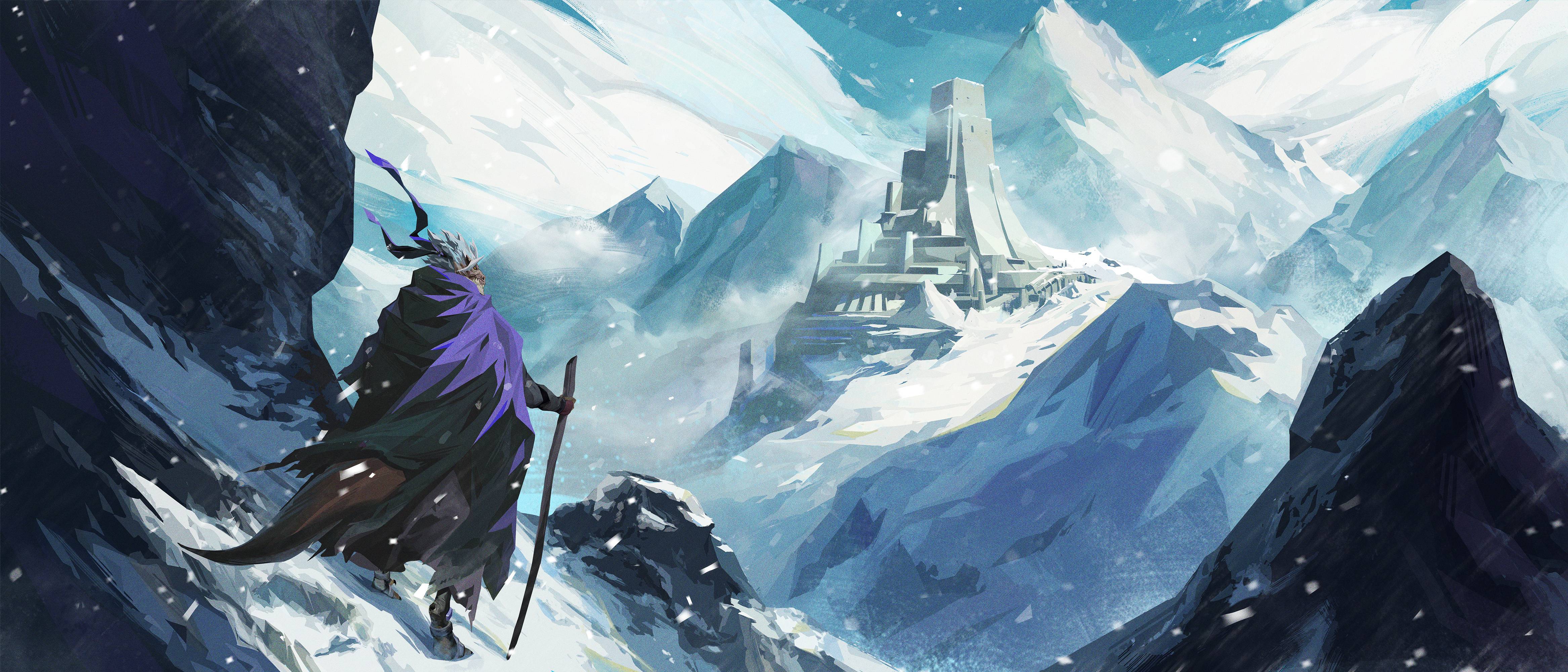
The deconstruction of legend was viewed by some as sacrilege, and the conflict between science and religion escalated. The Gektaras engaged in a prolonged civil war until a solution was reached -- a separation. The monk, Calumma, led her group of Gektaras underground and established the mining city, "The Deeps." The residents mine glunite, trading spirituality in favour of science and knowledge. The other Gektaras travelled up into the frigid mountains with the monk, Tegu. They built a sanctuary on Mount Laska and guard hoards of glunite within. These Gektara trade science in favour of meditation, tranquility and enlightenment. Today, in an era of peaceful cooperation between The Deeps and Mount Laska, the "Day of Enlightenment" remains an ancient mystery.